Many property owners ask what the minimum slope for metal roof systems should be before choosing a new roofing option. The answer depends on the type of metal roof being installed.
A mechanically seamed standing seam roof may be approved for lower slopes, while corrugated panels, exposed-fastener panels, and metal shingles often need more pitch to help water drain properly.
This matters most on low-slope roofs because water moves more slowly. If the wrong panel is used, water can sit near seams, screws, flashing, skylights, chimneys, valleys, or roof-to-wall areas. That does not always mean the roof will leak, but it does mean the panel type, underlayment, flashing, and manufacturer requirements need to be checked carefully.
The better question is not only, “Can I install a metal roof?” It is, “Which metal roof system is approved for this roof pitch?” This guide explains how roof pitch works, why metal panel type matters, and what property owners should confirm before choosing metal roofing for a low-slope roof.
The minimum slope for metal roof systems depends on the panel type, seam design, manufacturer instructions, local code, and roof conditions. Some mechanically seamed standing seam roofs may work on very low slopes, while corrugated panels, exposed-fastener panels, and metal shingles usually need more pitch to drain water properly.
There is no single minimum slope for every metal roof. The right answer starts with the exact panel being installed. Seam design, fastener type, underlayment, flashing, roof drainage, and warranty requirements can all affect whether a metal roof is a good fit for a low-slope area.
Some mechanically seamed standing seam systems may be approved for very low slopes. Other metal roofing options, such as corrugated panels, exposed-fastener panels, and metal shingles, usually need more pitch so water can move off the roof instead of sitting near laps, screws, and flashing.
This table is only a general guide. The final minimum slope should come from the manufacturer’s installation instructions, local building code, and the actual roof conditions.
If you are still comparing roofing materials, it may also help to review metal roof vs shingles before deciding which option fits your roof design, budget, and maintenance expectations.
IBEX Roof can inspect your roof pitch, drainage, and panel options before you choose a roofing system.
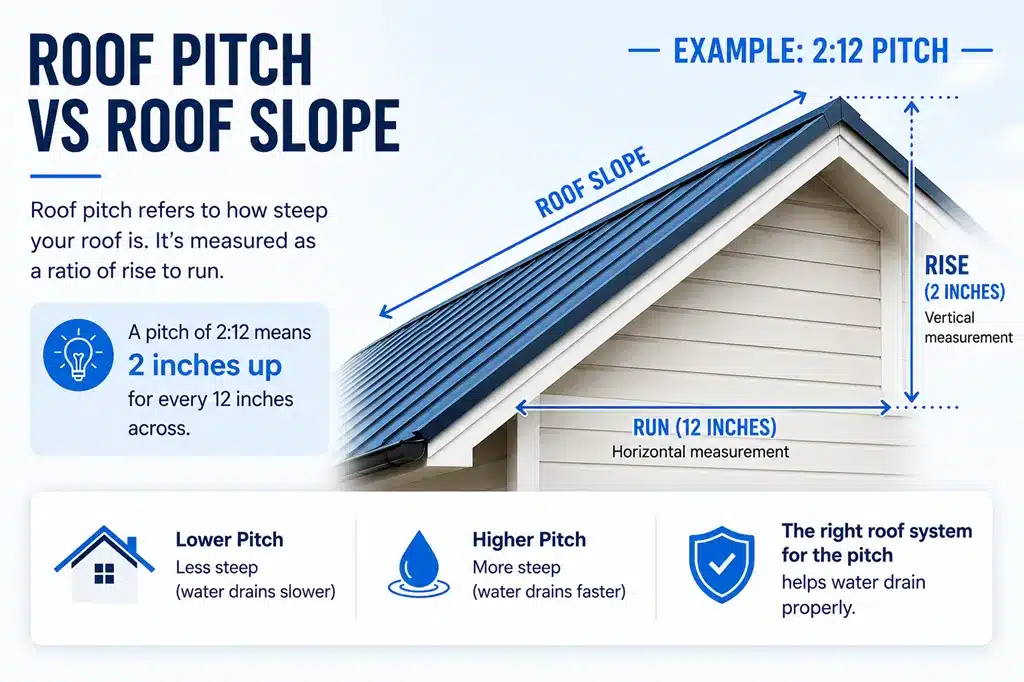
Roof pitch and roof slope are often used to describe the same idea: how steep the roof is.
Roof pitch is usually written as rise over run. For example, a 3:12 roof pitch means the roof rises 3 inches for every 12 inches of horizontal distance.
A lower number means a flatter roof. A higher number means a steeper roof.
| Roof Pitch | What It Usually Means |
|---|---|
| 1:12 | Very low slope |
| 2:12 | Low slope |
| 3:12 | Moderate-low slope |
| 4:12 and above | More common for many residential roofing systems |
A 1:12 roof is very low and needs careful review before metal roofing is considered. A 2:12 roof is still low slope, but some metal roofing systems may be approved for it. A 3:12 roof gives more options, but the panel requirements still need to be checked.
This is why roof pitch matters before choosing a metal roof. Two roofs can both be called “low slope,” but they may need different panels, seams, flashing, and underlayment.
Minimum slope matters because metal roofing is designed to shed water. When the roof is too flat for the panel being used, water can move slowly across the surface and sit near areas that are harder to seal.
That is why the panel type, seam design, fasteners, flashing, and drainage path need to match the roof pitch.
A steeper roof helps rain move off the panels faster. On a low-slope roof, water drains more slowly and may collect near seams, panel laps, screws, valleys, skylights, chimneys, vents, and roof-to-wall transitions.
These areas are already more vulnerable because they involve joints, openings, or changes in direction. If water sits there too long, small installation details become more important.
A low-slope roof does not automatically mean the roof will leak. The risk depends on the roofing system, the installation, and the roof design.
The concern is that slow-moving water has more time to find weak points. This can matter more on roofs with long panel runs, several penetrations, shaded areas, or sections where water drains from a steeper roof onto a flatter area.
Rain does not always fall straight down. During windy weather, water can be pushed sideways or even slightly uphill under laps, seams, or flashing.
A metal roof used on a low slope needs details that can handle that kind of exposure. This is one reason mechanically seamed standing seam systems are often considered before exposed-fastener or corrugated panels on lower-slope areas.
Metal roofs do not all work the same way. A mechanically seamed standing seam roof has a different seam design than a snap-lock standing seam roof. Corrugated panels and exposed-fastener panels also handle water differently because they often rely on panel overlaps, screws, and washers.
Metal shingles are different again because they are installed in overlapping pieces, more like traditional shingles. That design usually needs enough pitch for water to shed properly.
The minimum slope should not be guessed from a general online answer. The exact panel must be checked against the manufacturer’s installation instructions and local building code.
This also matters for warranty coverage. If a metal panel is installed below its approved slope, the product may not perform as intended, and warranty coverage may be affected.
The minimum slope for a metal roof depends heavily on the type of panel being used. Two metal roofs can look similar from the ground but have very different seam designs, fastening methods, and pitch requirements.
This is why the exact panel matters. A quote that only says “metal roof” is not specific enough for a low-slope roof. The roofing contractor should be able to name the panel type, explain how it is fastened, and confirm whether the manufacturer allows it on that roof pitch.
For broader industry context, the Metal Construction Association’s metal roof installation manual is a useful reference for metal roofing installation details. The final decision should still come from the exact panel instructions, local code, and the actual roof conditions.
Mechanically seamed standing seam is often the better metal roofing option for low-slope areas. The panel seams are folded and locked together with a seaming tool, which helps create a tighter connection between panels.
This type of system may be used on some low-slope residential and commercial roof areas when the panel is approved for that pitch. It is commonly considered where water resistance is a major concern.
Still, not every standing seam roof has the same minimum slope. A mechanically seamed standing seam system should not be treated the same as a snap-lock system. The roof inspector or roofing contractor should check the exact panel profile, manufacturer instructions, underlayment requirements, and flashing details before installation.
Snap-lock standing seam panels can work well on many roofs, but they may need more pitch than mechanically seamed systems. Instead of being mechanically locked with a seaming tool, the panels snap together along the seams.
That difference matters on low-slope roofs. If water drains slowly, the seam design has to be approved for that condition. Some snap-lock systems may be suitable for certain lower slopes, but they should not automatically be used on very low-slope roofs.
The manufacturer’s minimum slope requirement should be checked before choosing this type of panel.
Corrugated metal panels are common on sheds, barns, garages, utility buildings, and some homes. They are often chosen because they are widely available and can be more affordable than some standing seam systems.
For low-slope roofs, corrugated panels need extra caution. Many corrugated systems use exposed fasteners and panel overlaps. If the roof is too flat, water can sit near the laps, screws, and washers instead of draining away quickly.
Because of that, corrugated metal roofing is usually better for steeper slopes. It may not be the right choice for very low-slope roof areas unless the specific product is approved for that use.
Exposed-fastener metal panels use screws through the face of the panel. The screw heads and washers remain visible after installation.
These systems often need enough pitch to move water off the roof quickly. On a low-slope roof, slow drainage can place more stress on the screws, washers, fastener holes, and panel laps.
Exposed-fastener panels can make sense for some buildings, but they are not always the best option for low-slope residential roofs. Before using this type of panel, the roof pitch and manufacturer requirements should be confirmed.
Metal shingles and stone-coated metal roofing are designed to look more like shingles, shakes, or tiles. They are installed in overlapping pieces, so they usually need enough slope for water to shed over each course.
That overlap design is different from a standing seam panel. On a very low-slope roof, water may not move off the surface fast enough for this type of system to perform as intended.
Metal shingles can be a good fit for many pitched roofs, but they are usually not the first choice for flat or very low-slope areas.
For a closer comparison of panel styles, see this guide on standing seam vs metal shingles.
A completely flat or nearly flat roof may be better suited for a membrane roofing system instead of standard metal roofing. Common examples include TPO, PVC, EPDM, and modified bitumen.
Metal roofing is made to shed water. It is not meant to hold standing water for long periods. If the roof has ponding water, poor drainage, or a pitch below the approved range for metal panels, a membrane system may be the better option.
A roofing contractor can inspect the roof slope, drainage pattern, and existing roof design to help determine whether metal roofing or membrane roofing makes more sense.
A 1:12 pitch is very low slope. Metal roofing may only work if the exact panel system is approved for that pitch. In some cases, a membrane roof may be the better option.
A 1:12 pitch means the roof rises 1 inch for every 12 inches of horizontal run. At this pitch, water drains slowly, so the metal roofing system has to be chosen carefully.
Some specialized mechanically seamed standing seam systems may be approved for very low slopes. Standard corrugated panels, exposed-fastener panels, snap-lock panels, or metal shingles should not be assumed to work on a 1:12 roof.
Before choosing metal roofing for a 1:12 pitch, a roofing contractor should confirm:
This is one of those roof pitches where the exact product matters. A general answer like “yes, metal roofing can go on low slope” is not enough. The roof needs a system that is specifically approved for the pitch and designed to manage slow-moving water.
A 2:12 pitch may work with some standing seam metal roofing systems, but it is not suitable for every metal panel. The panel must be approved for that slope before installation.
At this slope, water still drains slowly, so the roof needs a panel system that is made for low-slope use.
Certain standing seam systems may be approved for a 2:12 roof. Mechanically seamed standing seam is often the stronger option to review first because the seams are locked together more tightly than many snap-lock or exposed-fastener systems.
Corrugated panels, exposed-fastener panels, and metal shingles need more caution. Some products may require a steeper pitch, and slow drainage can make laps, screws, washers, and flashing details more vulnerable.
Before accepting a quote for a 2:12 metal roof, ask what exact panel is being recommended. A quote that only says “metal roof” is too vague. The roofer should be able to explain the panel type, minimum slope requirement, underlayment, flashing plan, and whether the manufacturer allows that product on a 2:12 pitch.
If the existing roof is near the end of its service life, roof replacement may also be the right time to review whether a standing seam system, another metal panel, or a different roofing material fits the pitch.
A 2:12 roof is not an automatic no for metal roofing, but it should not be treated like a standard pitched roof either. The product approval, drainage path, and installation details need to match the slope.
A 3:12 pitch gives more metal roofing options than a 1:12 or 2:12 roof, but the exact panel requirements still need to be checked.
A 3:12 pitch sheds water better than lower-slope roofs, so some metal roofing systems may be approved for it.
Many property owners start seeing more choices at this range. Some standing seam panels, corrugated panels, and exposed-fastener panels may be suitable, depending on the exact product. Metal shingles may also be an option, but they still need to meet the manufacturer’s minimum pitch requirement.
The main point is that 3:12 should not be treated as automatic approval for every metal roof. A roof installer should still check the panel type, seam design, fastener system, underlayment, flashing details, local code, and warranty requirements.
If you are comparing a 2:12 pitch and a 3:12 pitch, the 3:12 roof is usually more forgiving. It gives water more slope to move off the roof, but the final answer still depends on the specific metal roofing system being installed.
The lowest pitch for a metal roof depends on the panel system. Some mechanically seamed standing seam systems may be approved for very low slopes, while flat or nearly flat roofs may need membrane roofing instead.
A metal roof should not be chosen by pitch alone. The roof pitch needs to be matched with the exact panel, seam design, fastener system, underlayment, flashing, drainage, local code, and warranty requirements.
| Roof Pitch | General Guidance |
|---|---|
| 1:12 | Very low slope. Metal may only work with a specialized system approved for that pitch. |
| 2:12 | May work with some standing seam systems, but not all metal panels. |
| 3:12 | More options are usually available, but product requirements still need to be checked. |
| 4:12 and higher | Usually more flexible for many residential metal roofing systems. |
A flat or nearly flat roof may need a membrane roofing system instead of standard metal roofing. This is especially important if the roof has ponding water, poor drainage, or several low-slope transitions.
The safest way to answer this is to match the roof pitch with the exact panel being installed. A roofing contractor should confirm the manufacturer’s instructions and local code before recommending the lowest slope for a metal roof.
Building codes may include minimum slope requirements for different roof coverings. For metal roofing, the code question should be checked along with the manufacturer’s installation instructions for the exact panel being used.
Building code requirements should be checked against the roof covering being installed. Property owners can review general roof assembly information through the International Building Code roof assembly requirements, but the final requirement still depends on the local jurisdiction, the exact roof system, and the manufacturer’s instructions.
This is important because a general code requirement may not tell the full story. One metal panel may be approved for a lower slope, while another panel from a different manufacturer may need more pitch. Seam design, fastener type, underlayment, flashing, and drainage details can also affect whether the system is appropriate for the roof.
Local requirements can vary by jurisdiction, so property owners should not rely only on a generic online answer. A roofing contractor should verify that the proposed metal roof system meets the applicable building code and the manufacturer’s requirements before installation.
For low-slope roofs, both points matter: the roof system needs to be allowed by code, and the exact product needs to be approved for that slope.
Metal roof manufacturers design each panel for specific installation conditions. Roof slope is one of those conditions.
If a panel is installed below its approved minimum slope, it may not drain water the way the manufacturer intended. That can create problems around seams, laps, fasteners, flashing, and roof penetrations. It may also affect warranty coverage if the installation does not follow the manufacturer’s requirements.
This is why the exact panel name should be listed in the quote or proposal. The warranty question is not only, “Is this a metal roof?” A better question is, “Is this exact metal panel approved for this roof pitch?”
Before installation, a roofing contractor should confirm the panel type, slope rating, underlayment requirements, flashing details, and warranty terms. This is especially important for 1:12, 2:12, and other low-slope roof areas where water drains more slowly.
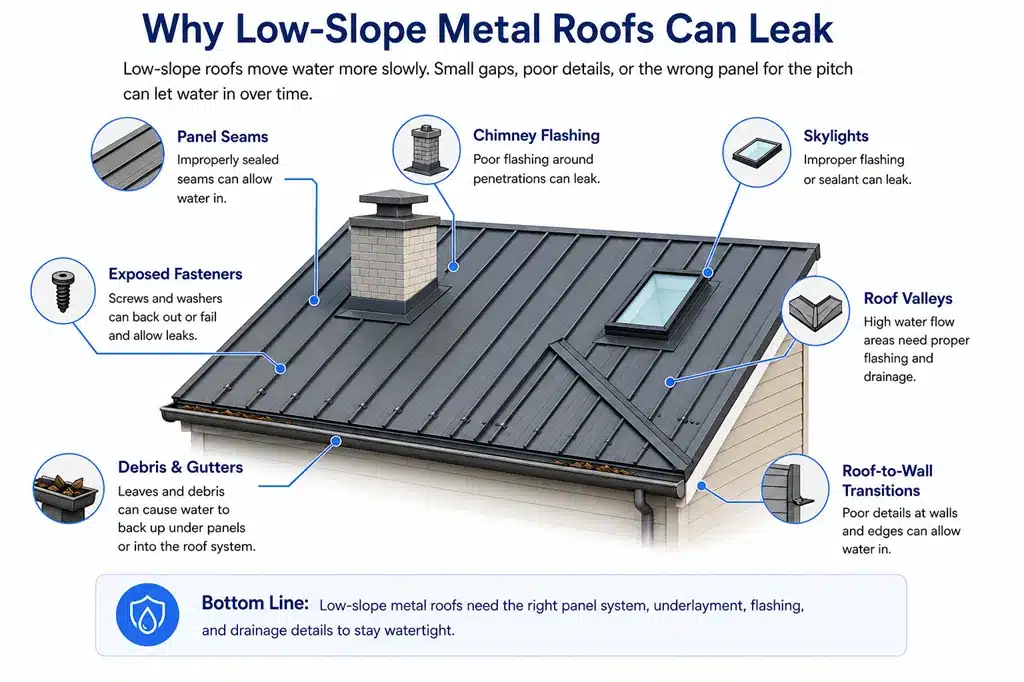
Low-slope metal roofs can leak when the roof system is not designed for slow drainage. The problem is not always the metal itself. It is often the wrong panel, weak flashing details, exposed fasteners, poor drainage, or a roof pitch below the product’s approved range.
If water is already getting past seams, fasteners, flashing, or roof penetrations, a roofing contractor may recommend roof repair after checking whether the issue is isolated or part of a larger roof problem.
On a steep roof, rain has more help moving off the surface. On a low-slope roof, water travels more slowly and can sit near seams, laps, screws, valleys, skylights, chimneys, and roof edges.
That extra time matters. If there is a small gap, loose fastener, worn washer, or poorly sealed transition, slow-moving water has a better chance of finding it.
Some metal panels rely on overlaps where one panel sits over another. These laps need enough slope so water keeps moving down the roof.
If the slope is too low for that panel, water can back up near the lap instead of draining cleanly. Wind-driven rain can make this worse by pushing water sideways or under the overlap.
Exposed-fastener panels use screws through the face of the metal panel. Each screw usually has a washer that helps seal the opening.
On a roof with enough pitch, water moves past those fasteners more quickly. On a low-slope roof, water may sit around screws and washers longer. Over time, that can make fastener holes, worn washers, or loose screws more vulnerable to leaks.
Flashing is the metal or waterproofing detail used around areas where the roof changes direction or has an opening. On low-slope roofs, flashing needs extra attention because water is not moving away as quickly.
Common leak-prone areas include:
These areas do not automatically fail, but they should be reviewed carefully before choosing a metal roof system for a low-slope area.
Leaves, branches, moss, and gutter debris can slow water movement on any roof. On a low-slope roof, that effect can be more noticeable because the roof already drains more slowly.
This is especially important on shaded or tree-covered properties. If debris collects near valleys, gutters, panel laps, or roof transitions, water may sit longer than the roofing system was designed to handle.
Regular roof maintenance can help keep gutters, valleys, moss, leaves, and other drainage areas from creating avoidable water movement problems.
For more detail on leak causes, flashing issues, and repair considerations, read this guide on why a metal roof may leak.
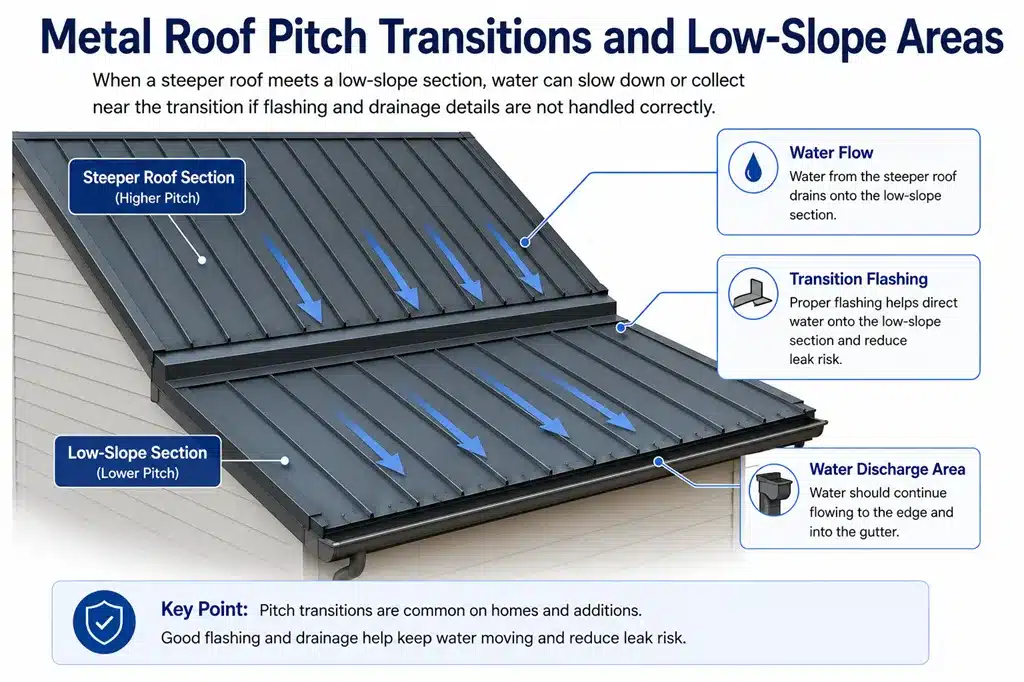
Some roofs do not have the same pitch from top to bottom. A roof may start with a steeper section, then change into a lower-slope porch roof, addition, garage roof, or covered entry.
These pitch transitions need careful planning because water from the steeper roof can drain onto the lower-slope area. If that lower section is not designed to handle the extra water, leaks can develop near the transition.
A metal roof pitch transition usually needs the right combination of panel choice, flashing, underlayment, and drainage. The lower roof section may also need a different roofing system than the steeper section.
For example, a standing seam panel may work on the main roof, but a very low-slope section below it may need special flashing or a membrane roofing system instead. The answer depends on the roof pitch, water flow, roof length, penetrations, and manufacturer requirements.
A roofing contractor should inspect any metal roof transition to low slope before installation. The goal is to make sure water can move from one roof section to the next without backing up under panels, seams, or flashing.
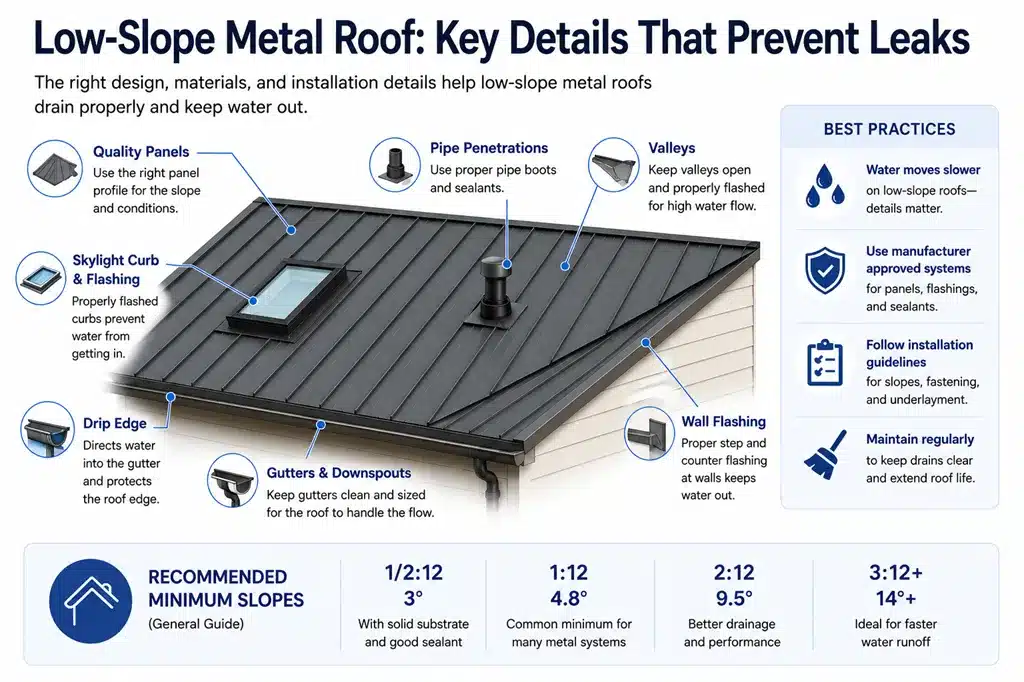
Underlayment is the layer installed beneath the metal roofing panels. It helps protect the roof deck if water gets past the outer roofing material, but it should not be treated as a fix for the wrong panel or the wrong slope.
For low-slope metal roofs, the underlayment requirements depend on the roof pitch, panel type, manufacturer instructions, and local code. Some systems may call for synthetic underlayment, ice and water shield, or a self-adhered membrane in certain areas.
Low-slope areas often need closer attention around:
These are areas where water can slow down, collect, or be pushed by wind. The underlayment should support the full roofing system, especially where water is more likely to find a weak point.
The main thing to remember is simple: underlayment is a backup layer, not permission to install the wrong metal panel on the wrong slope. The panel system still needs to be approved for the roof pitch, and the flashing details still need to be installed correctly.
For property owners comparing roofing companies in Vancouver, WA, the roof pitch, drainage pattern, and panel choice should all be reviewed before choosing metal roofing.
Rain, shade, tree debris, and damp roof areas can all affect how quickly water leaves the roof. On a steeper roof, water has an easier path toward the gutters. On a low-slope roof, water moves more slowly, so the panel type and flashing details matter more.
This is especially important around:
A low-slope metal roof may still be possible, but the roof inspector should look at more than the pitch number. The drainage pattern, roof length, debris buildup, penetrations, and gutter layout should all be checked.
For homes and buildings in the Pacific Northwest, a roof inspection can help confirm whether the roof pitch, drainage path, and panel choice are a good fit for metal roofing.
A low-slope roof needs more than a general metal roofing recommendation. Before choosing a panel, it helps to ask clear questions about the pitch, drainage, flashing, and product requirements.
Use these questions when reviewing a quote or speaking with a roofing contractor:
These questions can help property owners avoid vague answers. If a quote only says “metal roof” without naming the panel type, seam design, and slope rating, it is worth asking for more detail before moving forward.
IBEX Roof can check your roof pitch, panel recommendation, drainage areas, and flashing details before installation.
Metal roofing can be a good option for many homes and commercial buildings, but it is not the right answer for every roof. The roof pitch, drainage, panel type, and existing roof design all need to work together.
Metal roofing may not be the best fit when the roof is completely flat or nearly flat. Standard metal panels are made to shed water, not hold standing water. If water ponds on the roof after rain, a membrane system may be a better option.
Metal roofing also needs caution when:
This does not mean metal roofing should be avoided. It means the roof should be matched with the right system. A steep main roof may be a good fit for metal panels, while a flatter porch, addition, or transition area may need a different roofing material.
A roof inspector can review the pitch, water flow, roof penetrations, and drainage pattern before a roofing contractor recommends metal roofing. That step helps property owners avoid choosing a panel that looks right but is not approved for the roof conditions.
The minimum slope for a metal roof depends on the exact roof system. Some mechanically seamed standing seam roofs may work on low slopes, while corrugated panels, exposed-fastener panels, and metal shingles usually need more pitch to drain water properly.
Before choosing a metal roof, property owners should confirm the roof pitch, panel type, manufacturer requirements, underlayment, flashing, drainage, local code, and warranty coverage. This is especially important for 1:12, 2:12, and other low-slope roof areas.
If you are considering a metal roof in Vancouver, Portland, Camas, Lacey, or nearby areas, IBEX Roof can inspect your roof, confirm the pitch, and explain which roofing options fit your property.
IBEX Roof can inspect your roof, confirm the pitch, and explain which roofing options fit your property.
There is no single minimum slope for metal roof systems because each panel type has its own requirements. The approved slope depends on the seam design, manufacturer instructions, local code, and roof conditions. Some mechanically seamed standing seam systems may work on very low slopes, while other metal panels need more pitch.
The minimum pitch for a metal roof depends on the exact product being installed. Metal roofing needs enough pitch to move water away from seams, fasteners, flashing, and roof penetrations. A roofing contractor should confirm the panel’s approved slope before installation.
A 2/12 pitch may be enough for some standing seam systems, but it is not suitable for every metal panel. Corrugated panels, exposed-fastener panels, and metal shingles may need more pitch. The product must be approved for that slope.
A 1/12 pitch is very low slope. Some specialized mechanically seamed standing seam systems may be approved for this type of roof, but standard metal panels should not be assumed to work. In some cases, a membrane roofing system may be a better option.
Standard metal roofing is usually not the best choice for a completely flat roof. Metal panels are designed to shed water, not hold standing water. Flat roofs often need membrane systems such as TPO, PVC, EPDM, or modified bitumen.
The minimum slope for standing seam metal roofing depends on the system. Mechanically seamed standing seam panels may be approved for lower slopes than some snap-lock panels. The manufacturer’s instructions should always be checked for the exact panel.
Corrugated metal roofing usually needs more slope than mechanically seamed standing seam roofing. The exact pitch depends on the panel profile, fastener system, panel laps, and manufacturer requirements. It should not be assumed suitable for very low-slope roofs.
Low-slope metal roofs can leak when the wrong panel is used or when water drains too slowly near seams, laps, fasteners, flashing, and roof penetrations. The risk is higher when the panel is not approved for the pitch or when drainage problems are not corrected.
Underlayment helps protect the roof deck, but it does not make the wrong panel suitable for a low-slope roof. The metal roof system still needs the right slope rating, seam design, flashing, drainage, and manufacturer approval.
Yes, roof slope can affect warranty coverage. If a metal panel is installed below its approved minimum slope or outside the manufacturer’s instructions, coverage may be affected. The exact panel requirements should be confirmed before installation.
They were very responsive to a couple of installation issues and followed through with the business philosophy of finding a solution that would work. Thanks Jeff for your work... read more

 Jerry Willey
I wont to thank all of the people that worked extremely hard on both in being honest and doing a great job, and in fast in have enough... read more
 Jody Koelling
Nick and Jeff E. were great. They both took the time to make sure we understood our options, answered our questions and we were able to make the best choice... read more
 Donavan Anderson
Good price for good work. Crew did full strip and reroof for our two story house in 2 days. Looked great when done. Important to work with a roofing company... read more
 Steve Wetterling
Jeff Eason did a fantastic job and found cost effective ways to avoid high costs
 John Bonomi Jr.
We actually stumbled across IBEX at the Tigard Festival of Balloons and scheduled a free estimate to have our roof cleaned. And I'm so glad we did! Miguel... read more
 Amanda Case
Jeff Eason, our project manager, made sure to handle our project with care and attention. He kept us in the loop of what was happening and was generous with providing... read more
 Rory Parsons
Jeff Eason took great care of me. He kept me up to date each step of the way. I added gutter replacement to my reroofing job and have me regrets!... read more
 Michelle Huffman
Jeff Eason project manager did a wonderful job and gave me the best deal on gutters
 Allen Kosin
Jeff Eason and his crew are professionals who care about the customer. He and his crew arrived promptly at scheduled times. The crew worked efficiently and the roof was installed... read more
 Laura Guerra